
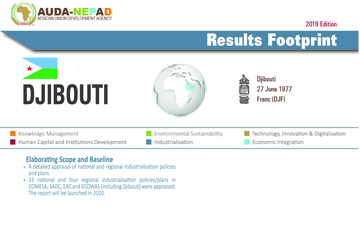
 Djibouti
Official Name: Republic of Djibouti
Capital: Djibouti
Independence Day: 27 June 1977
Currency: Franc (DJF)
Key Result
Advocacted for the ratification of the Protocol on the Rights of Women in Africa address human rights abuses suffered by adolescent girls in 16 African Union (AU) member states including Djibouti.
Djibouti is involved in the USD2.21 billion road link project which includes USD5.95 million for the rail section. The project spans a total of 8,715 kilometres of rail and road and is also combing the Trans-Africa Highway (TAH)-5 from Dakar to N’djamena and the TAH-6 from N’djamena to Djibouti.
Djibouti signed the CAADP Compact on 19 April 2012 committing to prioritise agricultural transformation and development. The country also completed an independent technical review of its National Agricultural Investment Plans (NAIPs) in April 2012.
The country has made significant progress towards implementing its NAIS and integrating CAADP principles and values. According to a Biennial Review, Comoros has achieved a 71% completion rate of the CAADP process and 18.1% of rural women have been empowered with access to productive assets in agriculture. Further evidence include: 10% annual growth of the agriculture GDP value addition; a score of 50 out of 100 for the Trade Facilitation Index (TFI), and 11.6% of agriculture land under sustainable land management practices.
Djibouti is among 11 African counties which are being supported by NEPAD through the Africa Extractives Capacity Assessment Framework (ECAF). This support is aimed at enabling sustainable extraction and utilisation of mineral resources as well as domestication of the African Mining Vision into the mining policy and regulatory frameworks. There is now increased awareness and competence among key actors in contract negotiations and tax policies related to the extractive and mining industry.
Related
Projects
African Medicines Regulatory Harmonisation (AMRH)

Comprehensive Africa Agriculture Development Programme (CAADP)

Programme for Infrastructure Development in Africa (PIDA)

Capacity Development

Advocacy and Strengthening of Negotiation Capacities on Post-2015 Development Agenda through the Common African Position (CAP)
Global Partnership for Effective Development Cooperation (GPEDC)
The Global Partnership is an inclusive political forum bringing together governments, bilateral and multilateral organisations, civil society and representatives from parliaments and the private sector, committed to strengthening the effectiveness of development co-operation to produce maximum impact for development. Through its multi-stakeholder platform, the Global Partnership provides support, guidance and shares knowledge to boost development impact with a strong country focus, and to ensure a degree of coherence and collaboration among all development stakeholders on co-operation flows and policies. It offers a global mechanism to ensure co-operation is based on Busan principles of ownership, results, inclusiveness; and transparency and accountability to deliver tangible results on the new SDGs. NEPAD Agency is the Africa’s Secretariat for the Global Partnership.
Presidential Infrastructure Champion Initiative (PICI)
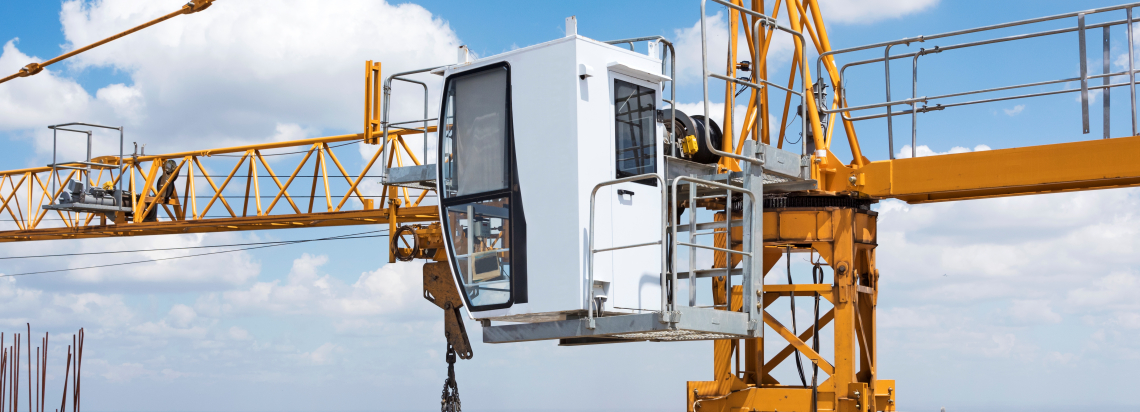
Project : Dakar-Ndjamena-Djbouti Road/Rail Project
Description : An 8 715 km road/rail project which entails combining TAH 5 (Dakar to N’djamena) and TAH 6 (N’djamena to Djibouti)
Estimated total cost : USD2.21 billion for the road link and USD5.95 for the rail section
Description : The use of political gravitas and goodwill to unblock and facilitate political bottlenecks affecting the implementation of ICT broadband and optic fibre projects on the continent
Africa UN Food Systems Summit Knowledge Hub
